I’m in Texas for AfroTech, soaking in the energy of being among people I’ve dreamed of being around for a long time—intellectual, driven, melanated folks talking about ideas, ambition, and futures that feel familiar to mine.
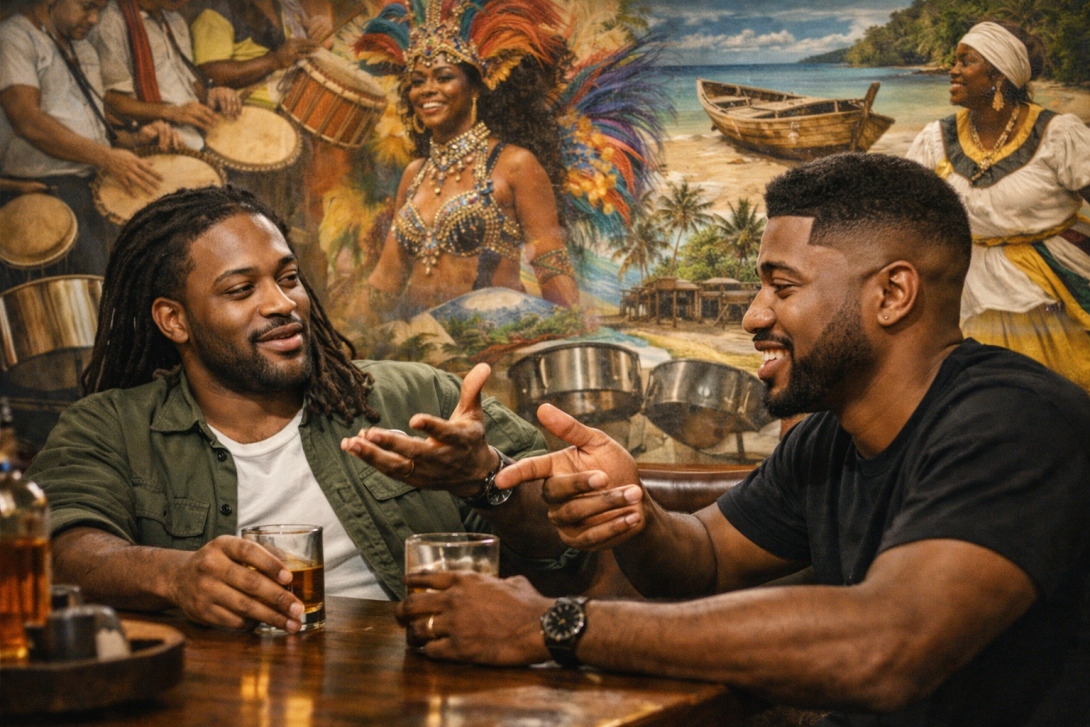
Between sessions, I take a break and sit at a bar to grab a meal. A man walks in and sits facing me. He has locs, a strong build, and carries himself with a serious demeanor—an air of both curiosity and guardedness. He looks over and says, “Hey, what’s good?”
I respond, “Chillin’, bro. How you?” and offer a fist bump with a half-smile.
He asks if there’s an event happening in town. That question opens the door. I tell him about AfroTech—my first time attending—and the conversation shifts naturally into general thoughts and life experiences. At one point, he says something that sticks with me: he appreciated my energy, but admitted that more often than not, when meeting other brothers he can't help but to keep his guard up.
"Why is that?" he asks.
That question made me reflect on a phenomenon I’ve experienced my whole life.
On a macro level, there are layers to it—this country’s historical hostility toward minorities, minorities being suspicious of one another, and sometimes even individuals being suspicious of their own people.
I enter this narrative as a first-generation Garifuna American, born in 90s New York City, where distrust was the default. It was in the air long before I had language for it.
As a kid, I was warned by family members I deeply admire—people who loved me and wanted me to succeed—not to spend too much time around Garifunas, that I wouldn’t want “ignorance” to rub off on me. I was too young to challenge it, but old enough to feel the quiet shame embedded in the warning. And to be honest, some people do reinforce those stereotypes with their behavior, which makes the message harder to untangle.
In grade school, surrounded mostly by Latino, Black, and Brown kids like me, I made friends easily—but still questioned who I was and whether I truly belonged. Others seemed so sure of who they were and where they came from. As a kid, blending in was easier than digging deeply into identity. Speaking the same language or looking similar felt like enough.
As a young adult in the workplace, I often found myself as the only chocolate chip in a sea of frosting—automatically grouped with the few other minorities in the room, intentionally or not. There’s nothing inherently wrong with that; similar energy naturally gravitates together. But it feels different when you’re pushed there instead of choosing it—or when options are so limited that choice disappears.
I’m ashamed to admit that, at times, I avoided other people of color because of a few negative work experiences. That avoidance wasn’t rooted in hate—it was rooted in fatigue. Still, it’s something I have to own.
I wish more people understood that minorities in America are not a monolith. While many of us share a history shaped by colonization, that doesn’t erase the distinct ways we practiced life, love, spirituality, and community—before, during, and after. Just as Europeans differ widely between Russia, France, and England, our cultures hold deep differences within and among themselves.
Now I have children who are more diverse than I am, and I don’t want them growing up feeling lost the way I did—never fully understanding or appreciating their roots.
It often feels like our Euro-American brothers and sisters can trace their lineage back centuries, sometimes all the way to the pilgrims, long before DNA testing. Meanwhile, many minorities can trace only to grandparents, maybe great-grandparents if they’re lucky. Beyond that, the trail often ends in slavery, displacement, and abuse.
We grow up hearing things like, “I can’t stand [insert group here]—Garifunas, Puerto Ricans, Haitians ect.—they’re too much drama, gossip, ignorance.” These messages are often passed down not out of malice, but out of pain—from being hurt by your own people.
But we don’t always recognize how much of that negativity we inherit—or how deeply it harms us.
If someone carries resentment toward their own people, what do they pass down to their children?
So now, as an adult, I’m intentionally exploring my culture and history—and how it intertwines with so many others. I wish my earliest lessons had been about my family’s story, my rich cultural history, and where I come from, as fully as it could be explained.
Now that I’ve identified the problem, it feels like my responsibility to correct it where I can. For me, that starts small—with my kids we watch videos on Garifuna and Bajan culture, attend cultural events, observing, asking questions, planning trips when possible. More importantly, it means connecting with like-minded people and opening space for honest conversations—lowering our guard just enough to meet one another where we are.
Like the man I met at AfroTech. I was surprised—and happy—when he ordered a second drink to keep the conversation going. He told me about his military service, his relationships, and his life growing up as an melanated man in America.
I felt hopeful in that moment.
I'm truly blessed when a brother takes the chance—to pull up, to connect, and to make a small step toward changing our default.
I wished him well, and I meant it.