How do you raise children who can stand on their own without giving them the same trauma that made you strong?
It’s a question I keep coming back to.
My parents and grandparents probably wouldn’t have understood the question. In their world, hardship wasn’t something parents created or avoided. It was simply life.
When Children Were Part of the Work
Growing up in Honduras, children weren’t separated from the work of the family. My grandparents took their children into the mountains and brought them along to work. They didn’t just tell them how life worked. They let them experience it.
Children learned responsibility by carrying it. They understood that the family depended on everyone’s contribution.
Responsibility wasn’t something introduced at eighteen.
It was part of childhood.
When my family immigrated to New York, that world changed.
The culture around us valued individualism more than the community my parents had known. At the same time, parents became increasingly protective. Children weren’t expected to contribute in the same ways because life looked different. There were concerns about violence, drugs, crime, and influences that my parents wanted to shield us from.
I grew up hearing the same messages.
Don’t stay out late.
Don’t travel alone.
Don’t talk to strangers.
Be careful who you trust.
The adults were trying to protect us, and I understand why.
But then I would hear another message:
“The kids gotta move out by eighteen.”
That always felt contradictory.
We spend about eighteen years teaching children that the world is dangerous, then expect them to confidently step into it overnight.
Independence Isn’t an Address
For a long time, I accepted that philosophy with a grain of salt because independence has always been important to me. But I also noticed something that didn’t add up.
Many of the people I watched move out because they were “supposed to” weren’t actually prepared. They met the expectation, but they struggled because independence had become a deadline instead of a process.
The older I get, the less I believe independence is measured by an address or marital status.
Someone can move into their own apartment and still rely on everyone else to solve their problems.
Someone else can still live at home while contributing meaningfully to the household, pursuing a vision for their life, and preparing for whatever comes next.
To me, independence isn’t moving out.
It’s learning to carry responsibility.
If one of my children wants to move out, I want them to know how to manage their finances, cook their meals, maintain a home, build healthy relationships, and contribute to their community.
If they choose to stay home longer, I don’t want them simply benefiting from everyone else’s work. I want them sharing the responsibilities of the household as another adult.
That means contributing financially when they’re able, helping maintain the home, caring for younger siblings or aging family members when needed, and actively pursuing goals that move their life forward.
The goal isn’t to get them out of my house.
The goal is to make sure they never stop growing.
I joke that if my twenty-five-year-old is still enjoying the comfort of their childhood bedroom with no direction in life, maybe I don’t need a four-bedroom house anymore. We’ll downsize to two bedrooms.
If that doesn’t work, maybe one bedroom.
If we’re still stuck, I guess we’ll all be living in a car.
It’s a joke.
But underneath it is something I genuinely believe.
Comfort should never become an excuse to stop contributing.
Does Strength Require Suffering?
There’s a popular saying that hard times create strong people, strong people create good times, good times create weak people, and weak people create hard times.
Maybe there’s some truth in it.
But I don’t want suffering to be the only way my children learn strength.
What interests me is whether we can interrupt that cycle.
Is there a way to raise children who become strong without requiring the hardship that made previous generations strong?
Is it possible to pass down resilience intentionally instead of waiting for suffering to teach it?
Could that kind of strength endure across generations and changing circumstances?
The strength I have today wasn’t produced by a parenting strategy.
It came from circumstances.
My parents weren’t trying to make me resilient.
They were trying to survive.
Like many immigrant families, they came to the United States believing they would work, save money, and eventually return home to Honduras. Money stretched much further there than it did in New York, so supporting family back home often meant helping more people than spending the same amount here.
Their sacrifices shaped my childhood.
We rarely took vacations unless we were returning to Honduras. My parents worked long hours, and my siblings and I often spent long stretches at home without them.
They weren’t chasing luxury.
They were carrying responsibilities that extended far beyond our household.
The resilience I gained was a byproduct of watching my parents carry responsibilities that life had placed on their shoulders and learning, in my own way, to respond to those responsibilities too.
My children may not face the same circumstances.
I hope they don’t.
So the question becomes: If hardship is no longer the teacher, what takes its place?
I keep coming back to shared responsibility.
Give Them Something Real to Carry
My generation has a different challenge.
My parents didn’t have to engineer hardship.
Life did that for them.
If I want my children to become resilient, I have to think differently.
I don’t want to manufacture suffering.
I want to create opportunities for meaningful responsibility.
I don’t think resilience comes from hardship alone.
Maybe it comes from carrying weight that actually matters.
I don’t intend to protect my children from every challenge. I want to invite them into the work of the family.
I want them to help solve problems instead of simply benefiting from someone else’s solutions. I want them to experience what it means to contribute to something bigger than themselves.
The more I think about it, the more I believe that’s what my grandparents were really teaching: shared responsibility.
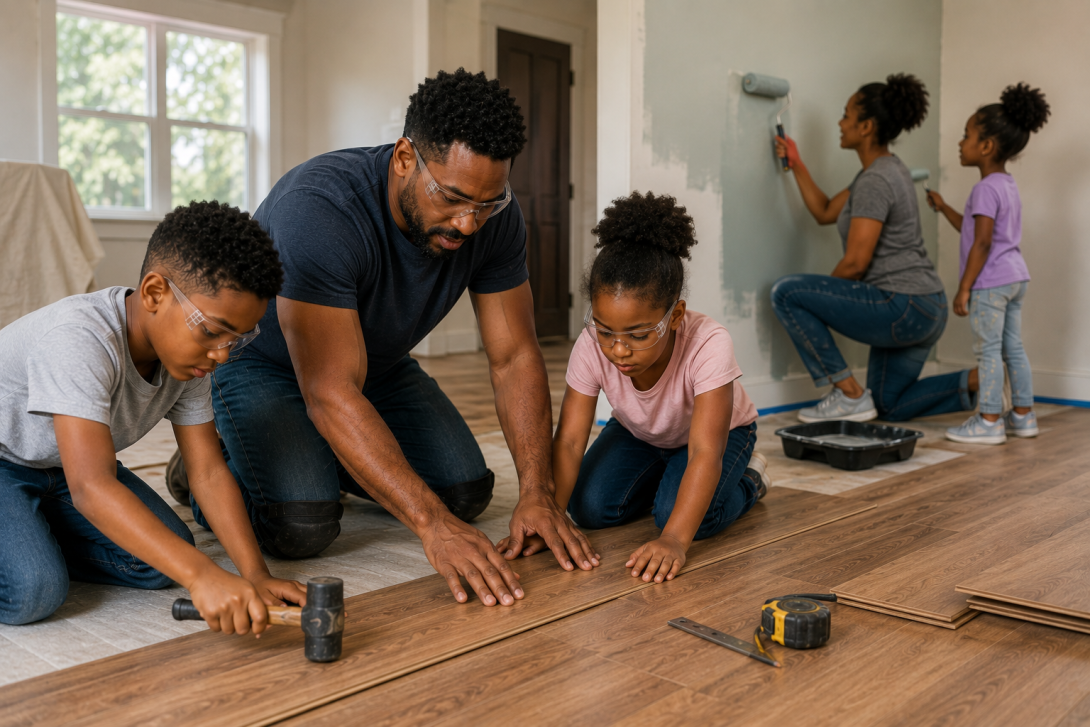
Whether it’s cooking dinner together, maintaining the house, serving in the community, caring for younger siblings, helping an elderly family member, or tackling a difficult project together, children learn responsibility by sharing it—not just by watching someone else carry it.
The responsibility has to be real enough that their contribution matters. It can’t be busywork designed merely to keep them occupied.
Modern life makes it easy to separate children from the responsibilities that help them become adults.
Some days, I understand the temptation.
Adult life is already filled with a thousand small decisions, and involving children often makes a task slower and messier. It can feel easier to carry the burden myself, hand them a distraction, and ask them to stay out of the way so I can focus.
But efficiency may come at a cost.
When I always choose the fastest way to finish the work, I may also be removing the experiences that teach them how to contribute.
Maybe that’s what we’ve slowly lost.
Not because parents care less.
Not because children are weaker.
But because we’ve confused protecting children with removing them from meaningful contribution.
More Than Moving Out
I’m still figuring out what this looks like in practice.
At what age do you begin sharing real responsibility?
How much should a child carry?
When do you step in, and when do you let them struggle?
I don’t have those answers yet.
But I do know this.
I don’t want to raise children whose greatest achievement is moving out.
I want to raise adults who know how to carry responsibility wherever they live.
If they choose to build a life somewhere else, I want them to leave prepared.
If they choose to stay home for a season, I want them to stand beside me as another contributing adult—not simply another mouth to feed.
Because independence isn’t measured by where you live.
It’s measured by whether others can depend on you.
And maybe that’s how we begin to break the cycle—not by passing down hardship, but by passing down shared responsibility.