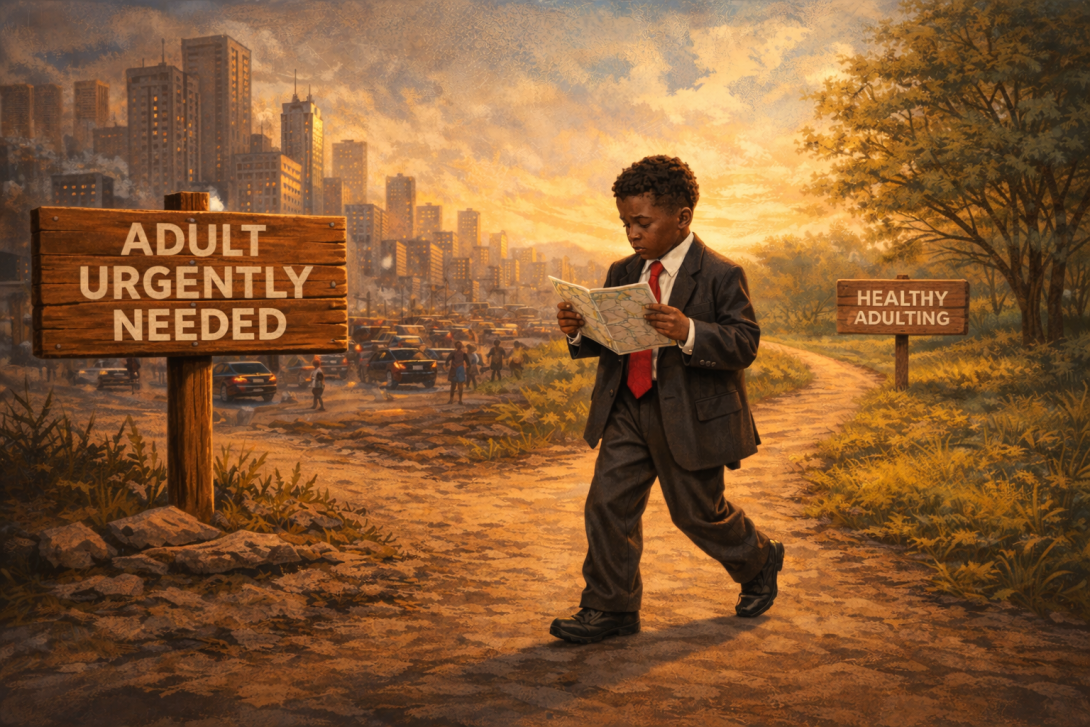
“Stop it. Stop crying. You’re the man of the house now, so stop crying!”
“I’m sorry, my son, but I have to go. I can’t stay here. It’s not working between your mom and I.”
I was eleven.
It was a family gathering where the adults had more energy than the kids — dancing Punta, singing Paranda late into the night. But when alcohol got involved, the celebration slowly turned into arguments. Eventually, the fighting grew loud enough that my siblings and I were sent to our rooms.
I laid in bed listening to my parents scream at each other. My mother dredging up old grievances, my father barraging her with years of unresolved pain. At some point, everything went quiet — except for me. I was crying, angry, trying to contain it, and failing.
They could hear me.
That’s when my father came into the room and delivered his message.
A few days later, he moved out.
That was the night I became “the man of the house.”
Becoming “The Man of the House”
When it officially settled in that my dad was gone, I took his words seriously: "Be the man of the house."
But no one explained what that actually meant. So I improvised.
I accepted, almost immediately, that my childhood was over. I forced myself to mature without understanding what maturity looked like. At home, I became a mediator — hyper-observant, reading moods, filtering my mother’s instructions to my siblings while she processed her own pain, stepping into conflicts that didn’t belong to me.
Outside the home — and outside my nature — I became reactive. I defended my siblings from bullies, but I also carried that tension back into our relationships. Protection and anger lived too close together for me to tell them apart.
All the while, I carried resentment and unprocessed trauma, but I believed that mastering my anxiety was part of being an adult. I thought emotional control meant emotional suppression.
That anxiety followed me well into my early thirties. I can’t fully say how much of that responsibility was self-imposed and how much was expected. Either way, I lived with the constant pressure of being responsible for my family’s stability — even when I wasn’t physically there.
How I Chased Adulthood
Traditional milestones never felt aspirational to me. They weren’t dreams — they were duties. Things that had to be done, whether I wanted them or not.
Education wasn’t about personal fulfillment. It was about proving what was possible and showing younger family members that there were multiple paths to learning — that student loans weren’t the only option, and that curiosity didn’t stop at graduation.
When I got my first car, it wasn’t freedom I felt. It was utility. I could get my family out of the neighborhood. I could create moments of relief — day trips, distance, perspective.
As I built my career, something unexpected happened: I named my first emergency contact who wasn’t my mother — my girlfriend at the time. That small administrative detail was actually a huge emotional shift. It meant I had built trust outside my family. I could be supported without being the pillar.
I eventually married that emergency contact. We had children. For the first time, I had the opportunity to build a family with a clean slate — to raise children differently, while still honoring where I came from.
Buying a house wasn’t about achievement. It was about creating space — literal and emotional. A place where my built family could grow without the chaos I grew up with. But it also became a bridge between worlds. When my birth family needed distance from New York’s noise — the physical noise and the emotional kind — there was somewhere to go.
Because New York City don’t know how to be quiet.
But the house did.
These milestones were less about me. They were infrastructure. They were my attempt at protection.
Why It Failed Me
As my family grew — in complexity and distance — the strain intensified.
Those who remained in the Bronx lived with ongoing anxiety, and so did I. My sense of worth became tied to problem-solving. If something went wrong and I wasn’t there to fix it early, I felt like I had failed.
By the time I got the call, the issue had already exploded. Siblings calling about my mom. My mom calling about my siblings. Elders bickering. Family infighting is ugly, and it pulled me back into my old roles fast.
I reached a point where I was hitting my limit. I felt torn between the life I was building and the life I was slowly — painfully — distancing myself from.
It felt like survivor’s guilt.
The truth was this: the identity I built to survive my childhood was no longer sustainable in adulthood.
What Corrected Me
The COVID-19 pandemic became an unexpected spiritual reset.
I say this as a morbid optimist — someone who was hospitalized and needed respiratory care for weeks. Nothing sharpens your relationship with life like getting close to losing it.
The pandemic forced me into a retreat I would have never chosen on my own. I slowed down. I focused on raising my family. I found a therapist who helped my heart catch up to what my mind already knew: I didn’t have to carry everything alone.
I learned that setting boundaries doesn't mean abandonment. They are structure. They create space — space for me to love myself and the people I serve, without disappearing under the weight of responsibility.
For the first time, I used some of the space I had always created for others… for myself.
What I Believe Adulthood Is Today
At this stage of my life, my desire is simple: I want the people around me to be okay — including me.
For years, I believed adulthood meant holding everything together, always having the answers, absorbing pain silently. But real adulthood isn’t emotional suppression, milestone chasing, or avoiding vulnerability.
Adulthood is about building infrastructure and boundaries so growth is possible for everyone involved.
When my father left, I didn’t experience it as abandonment. He still called. He still showed up on weekends. He stayed present. What changed wasn’t his care — it was his proximity — and that came with the loss of a layer of protection.
At eleven, protection meant physical presence. Someone bigger standing between chaos and the rest of us. When that presence disappeared, the weight of protection fell in front of me.
Now I see it differently.
My father didn’t run from responsibility. He stepped away from a relationship that had become untenable. That was a boundary — one he learned later in life.
My parents now live separate lives, building their own versions of peace. The lessons they learned later — about limits, space, and sustainability — I’m trying to apply now.
At eleven, I thought being the man of the house meant being silent and carrying everything.
It turns out it means building something strong enough that no one has to carry it alone.