During the pandemic, every time I came out of Costco or a grocery store and couldn’t immediately spot my car in the sea of parked vehicles, the same thought crossed my mind: Is this the day the Kia Boys got me?
Usually, I’d find it and laugh it off.
The paranoia wasn’t unfounded. News stories kept circulating about the Kia Boys—a loosely organized group turned viral phenomenon—stealing Hyundai and Kia cars with alarming ease. If your car was made between 2011 and 2022, it likely lacked an engine immobilizer, a basic anti-theft feature. All it took was popping off the ignition cover, sticking in a USB cable, and the car was gone. What started as a social-media trend led to crazy spikes in thefts, insurance nightmares, and a constant low-grade anxiety for owners like me.
Why didn’t I just get a new car? Part practicality, part ego.
This was my first car. I bought it in 2015 when I was living in boston after college, despite what other people though. It was a 2014 white Hyundai Elantra with a spoiler that gave it just enough sex appeal and speed. I loved it. Back then, I had some foresight. Rent prices were rising fast, and every year I found myself pushed a little farther away from the city. The car became less of a luxury and more of a necessity. I proudly paid it off in two years.
Fast forward to the COVID-19 pandemic. Used cars were as expensive as new ones thanks to global supply chain issues, so I stuck with what I had. I’ve always had a high tolerance for risk and figured I’d deal with the consequences if something ever happened.
Then something did.
In March 2025, my family and I drove to New York City to visit my mom. My kids were sick, but my son had it especially bad. During the drive, he threw up in the car. We cleaned it as best we could, brought the car seat cover inside to wash, and figured we’d put everything back together in the morning.
The next morning, the car wasn’t there and immediately felt that quiet, sinking confusion.
I searched up and down the block. Nothing. I called my wife to see if she’d moved it for some reason—no. I called the city to check if it had been towed—also no. That left only one option.
Calling the cops.
Two officers arrived and I was already on edge. Talking to police is stressful on a good day, and this wasn’t one. The questions escalated quickly.
When was the last time you saw the car?
Did you lend your keys to anyone?
Do you have enemies?
Is there anything in the car you don’t want us finding if it turns up?
I answered calmly, but eventually asked, half-joking, half-serious, “Do I need to start recording this interaction?”
They laughed and said no. They explained there had been an uptick in car thefts, and that if officers aren’t thorough, they could unintentionally contribute to insurance fraud—or even help someone steal a car.
Once the tension eased, I became more aware of where I was: the Bronx. A neighborhood where police relations have never been simple. Trying to preserve what little street credibility I still pretend to have, I joked that we’d been talking long enough that I probably looked like an informant. I told them they had to make me look tougher—maybe throw me in cuffs or something. The ops are watching!
Like some kind of divine comedy, one officer stepped away to talk on his radio. When he came back, he said, “You have to come with us.”
I laughed. “You serious?”
They were.
They put me in the back seat—no handcuffs—and as we drove, I looked out the window at the neighborhood I grew up in. The bodega where I used to buy chopped cheese. The streets where I pushed a big blue shopping cart while helping my mom run errands. The block where my dad used to live before retiring and moving out of town.
I had spent years worrying about losing this car. When it finally happened, it happened here.
Then we stopped.
And then the absurdity of it hit me: the car had been stolen from in front of my mom’s house and somehow ended up in front of my dad’s old building. Of all the places in New York, apparently even my stolen Hyundai was keeping it in the family.
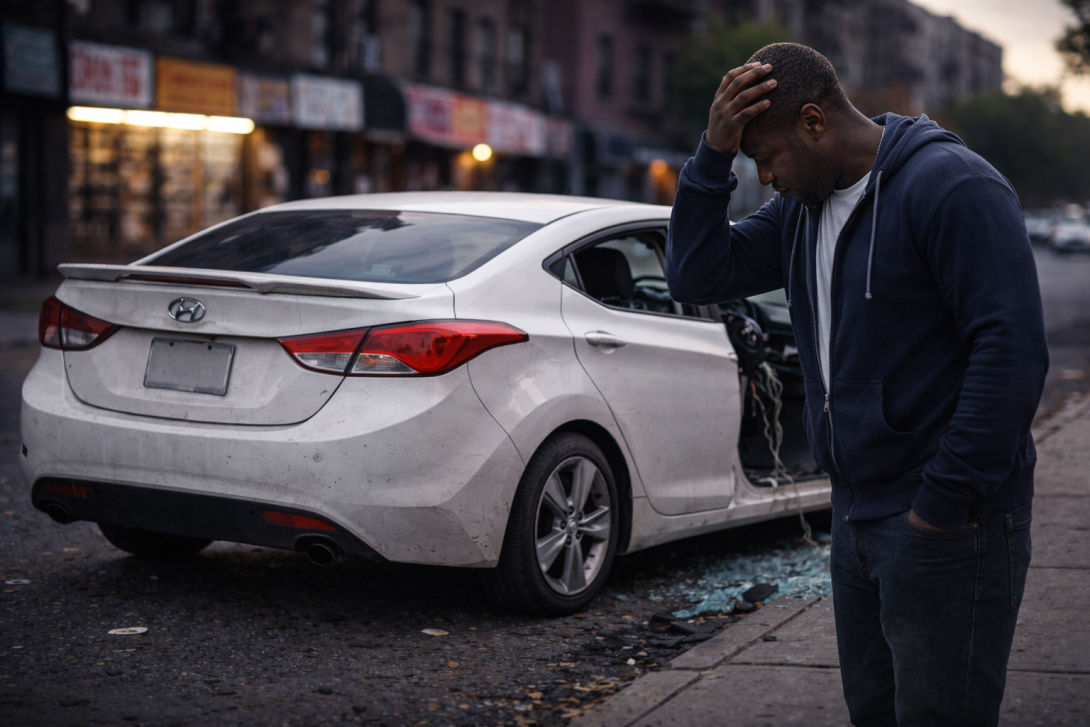
There was my car—windows smashed, ignition destroyed, car seats gone. A few cars down, another group of officers stood with another victim, hands on their head, staring at what was left of their vehicle. I didn’t need to hear their conversation to know it matched mine.
"Once we dust for prints and gather evidence, you can either drive the car away or have it towed." Said one officer
I called my wife to update her. I tried to sell her on the idea that we could still drive it home, avoid the headache of dealing with an out-of-state claim.
She chose the other option.
So the car got towed. I drove home in a rental. And the anxiety that used to live in grocery store parking lots finally had a reason.
Yeah—this was the day the Kia Boys finally got me.