My mother grew up in a tight-knit community in Honduras. Then, in her twenties, she arrived in the United States, where she became responsible not only for herself but also for people who depended on her, both in the states and back home.
In this chapter of her life, she navigated her new world with limited resources, hard circumstances and hard choices.
The side effects contributed to a tough home life for my siblings and I.
Growing up in a rough environment helped develop my resilience. The thing about toughness is that there is never a pleasant way to develop it.
Depending on where it comes from, it can leave resentment attached to its source. In my case, that source was my mother, and over time that resentment evolved into a more general anger.
For a long time, I carried that resentment with me.
When I Stopped Waiting for an Apology
At 18, I moved out of my mother's house for college. This freedom granted me the space to realize I needed to redefine my relationship with her.
At first, I wanted what can be considered, a very millennial solution: accountability. I wanted her to acknowledge what happened and apologize.
Hah!
Unsurprisingly, that approach led nowhere. The more I pushed, the more we both dug in our heels.
I needed a new approach. I started by sharing my life with her rather than try to change her.
I told her about my struggles at work, heartbreaks, financial worries, and the moments when I questioned how I was going to pull through. I wasn’t looking for advice or sympathy. I simply wanted her to know what was happening in my life.
No matter what we thought of each other, I knew we both cared. We just didn’t know how to communicate that care to one another.
Looking back, I can see that my mom has always carried pain, and no matter how she expeessed it I can tell that sometimes it blinded her to the pain of those she cared for. When I was younger, I didn’t always feel like my pain was taken seriously. But as an adult, I think the physical distance between us created room for a different kind of relationship to develop.
And somewhere along the way, she started opening up to me too.
Over time, our conversations felt less like a debate over the past and more like two adults trying to understand each other.
Seeing Both Sides
Before the cruise ever happened, I had become a parent.
Having children gave me something I didn’t have before: the ability to see both sides of the relationship.
I was no longer just a son evaluating a mother. I was also a parent trying to raise children of my own.
Parenthood didn’t erase the difficulties of my childhood, nor did it excuse everything that happened. What it did provide was context.
It showed me how often love and mistakes occupy the same space.
As I cared for my children, I began noticing things that seemed obvious, but easy to neglect for others. When my kids are scared, they want reassurance. When they’re hurt, they want comfort. When they’re hungry, tired, overwhelmed, or frustrated, their behavior changes.
The more I paid attention, the more I realized those needs don’t disappear when we grow up. We just get better at hiding them.
Adults still want reassurance when they’re afraid. We still want comfort when we’re hurting. We still struggle when we’re exhausted, overwhelmed, or carrying burdens we don’t know how to put down.
Seeing that in my children helped me recognize it in the adults around me, including my mother.
It showed me how easy it is to project our fears, limitations, and frustrations onto the people we care about most. Most importantly, it helped me to let go of the idea that my mother was supposed to be something more than human.
By the time the cruise came around, I already understood that she wasn't a hero or a villian. She was human.
The cruise simply gave me the opportunity to experience that truth.
The Vacation She Never Had
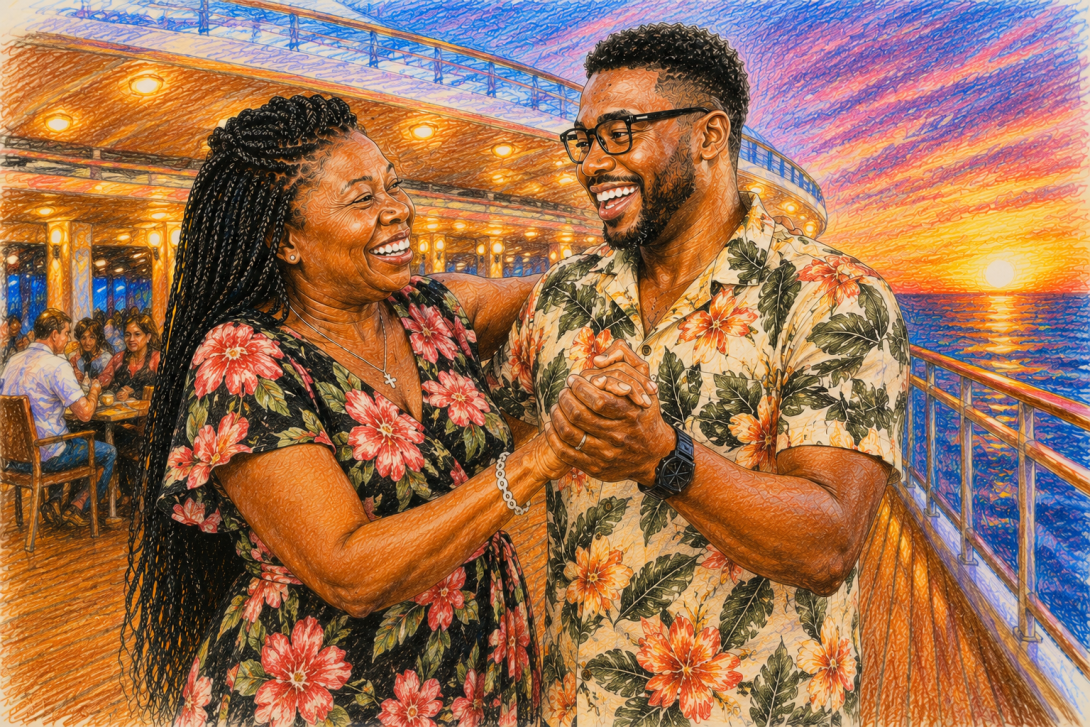
Eventually, I felt confident enough in myself and in our relationship to take my mother and aunt on a cruise.
My siblings were like, “Wow. You know she crazy, right?”
And they weren’t wrong.
But it ended up being one of the best experiences of our lives!
On that cruise, I got to see my mother outside of the role she played in my childhood.
I got to see what her insecurities looked like in real time.
One day we were walking through the atrium looking for a drink, and we noticed the bar was starting to get crowded. My mother had asked me to get her a drink.
Instead, I challenged her to get it herself.
Before she walked over, I reminded her to make eye contact and speak up because the bartender was multitasking.
A few minutes later she returned, frustrated.
“The bartender refused me.”
I chuckled and walked over to get the drink myself.
When I came back with it, her jaw dropped.
“How did you do that?”
The moment was funny, but it was also revealing. I could see how quickly she interpreted being overlooked as being rejected. I could see the insecurity underneath the frustration.
I also got to see what peace looked like on her.
There were moments when she stood quietly on the deck looking out over the ocean. No responsibilities. No one asking her for anything. No problem that needed solving. Just her and the water.
I also discovered how much my mother enjoys raunchy comedy.
The amount of swearing that came out of those comedians would’ve made my younger self uncomfortable.
But I was happy for her.
This was her first real vacation.
By this point in her life, now in her sixties, she had never taken a meaningful extended trip without responsibilities attached to it. Every vacation had been tied to family obligations, work, or some problem that needed attention.
This was the first time she experienced room service. The first time she had food prepared and waiting without having to think about it. The first time she could simply enjoy herself without carrying the weight of responsibility.
Watching her experience it all felt like watching a child discover something magical. There was wonder in it, and I was genuinely happy she got to experience it.
One of my favorite moments happened during a tour of a historic fort.
We were walking through exhibits about the island’s history and conflicts when we came across a display of old military artifacts.
Without reading the description, my aunt confidently announced that we were looking at a torture device—a medieval iron mask used to punish enemies.
My mother immediately accepted this as fact. She was horrified. Completely disturbed.
Then I pointed out that we were actually looking at old mortar shells.
The laughter that followed echoed throughout the fort was unforgettable.
Moments like that reminded me how much trust my mother places in the people she loves and how much faith she has in them.
Being Human
When I think back on that cruise, I don’t think about reconciliation.
I think about perspective. I think about seeing my mother outside of the story I had built around her.
I saw the woman who became nervous talking to a bartender. The woman who laughed at dirty jokes. The woman who stood quietly staring at the ocean. The woman who could still be amazed by room service and unlimited food.
I saw her insecurities, her humor, and her wonder.
I saw that she was human.
And that was the gift.