How do you raise children who can stand on their own without giving them the same trauma that made you strong?
It’s a question I keep coming back to.
I’ve written before about becoming the “man of the house” at eleven, about what can happen when responsibility arrives before you’re ready for it.
Now that I’m raising children of my own, I find myself wrestling with the other side of that experience.
How do I give my children responsibility without giving them my burdens?
Every parent has limitations. My parents had theirs. I have mine.
Parents can compensate for those limitations in all kinds of unhealthy ways. Some work excessively. Some become controlling. Some withdraw emotionally. Some enter unhealthy relationships. Some become physically or verbally abusive. Others disappear, even if they are still technically present.
Sometimes the child ends up filling whatever space the adults could not.
I know something about that kind of resilience.
The question isn’t whether my children will grow up with imperfect parents. They will. The question is whether I can respond to my own limitations differently, with communication, healthier relationships, a clearer sense of character, and enough honesty that my children don’t have to become strong simply by learning how to survive around me.
When Everyone Had a Job
My parents were born and raised in Honduras.
Growing up, children weren’t separated from the work of the family. My grandparents took their children into the mountains and brought them along to harvest crops and tend to cattle. They didn’t just tell them how life worked. They let them experience it. The children understood that the family depended on everyone’s contribution.
Responsibility wasn’t something introduced at eighteen. It was part of childhood.
When my family immigrated to New York, that world changed.
The culture around us valued individualism more than the community my parents had known. At the same time, parents became increasingly protective. There were concerns about abuse, drugs, crime, and other influences my parents wanted to shield us from.
I grew up hearing the same messages.
Don’t stay out late. Don’t travel too far alone. Don’t talk to strangers. Be careful who you trust.
The adults were trying to protect us, and I understand why.
I remember telling my dad as a kid that I wanted to work and help bring money into the house. I figured I could start by dumpster diving for bottles and cans. If I collected enough and returned them to the grocery store, maybe I could at least buy a gallon of milk!
Right?
I can still picture the look he gave me, proud but sad at the same time.
He told me, “You don’t have to worry about working. Just focus on being a kid.”
As disappointed as I was hearing that as a child, I understand his instinct differently now that I’m a parent.
He didn’t want to rush me into the sacrifices that increasing responsibility would eventually bring.
But there was a tension inside that protection that I didn’t understand until much later. It was the tension between how independence was defined inside my home and how it seemed to be defined everywhere else.
For years, so much of life was structured for me. Where to be. When to be there. What assignment came next. What success was supposed to look like.
Then adulthood arrived, and the expectation seemed to flip.
Now figure it out yourself.
I grew up being taught to be cautious about the world, follow existing structures, listen to adults, and stay away from danger. Then suddenly adulthood meant I was supposed to step into that same world on my own and prove I could survive in it. A world, I would eventually learn, was much messier than the plan I had been given. Most adults seemed to be flying by the seat of their pants too, trying to find or make their place in it.
I don’t want independence to arrive as a surprise for my children. I want them practicing it long before they leave home.
Independence Isn’t an Address
Many of the people I watched move out because they were “supposed to” weren’t actually prepared.
They got the apartment, the job, the bills, the furniture.
The appearance of adulthood.
But some were still struggling with the skills and judgment required to build a stable life. Independence had become a deadline instead of a process.
The older I get, the less I believe independence is measured by an address, paycheck, or marital status.
Someone can move into their own apartment and still rely on everyone else to solve their problems. On the otherhand, Someone else can live with thier parents while contributing meaningfully, pursuing a vision for their life, and preparing for whatever comes next.
To me, independence is about being able to take responsibility for your own life and contribute to the lives around you.
Whether my children leave home at eighteen, twenty-five, or somewhere in between matters less to me than whether they’re prepared. Can they manage their money, cook, maintain a home, build healthy relationships, solve problems, and recognize when something needs to be done without waiting for someone else to tell them?
The goal isn’t to get my children out of my house. It’s to make sure comfort doesn’t become stagnation.
I joke that if my twenty-five-year-old is still enjoying the comfort of their childhood bedroom with no direction in life, maybe I don’t need a four-bedroom house anymore. We’ll downsize to two bedrooms.
If that doesn’t work, maybe one.
If we’re still stuck, I guess we’ll all be living in a car.
It’s a joke, but there’s truth underneath it. I care less about where my children live than whether they’re growing and contributing. If they stay home longer, I want them helping run the household, not simply benefiting from it, while continuing to move their own lives forward.
Does Strength Require Suffering?
I understand why people believe hardship creates strength.
A lot of the strength I recognize in myself came from difficult circumstances. What I’m less convinced of is that suffering deserves all the credit.
The strength I have today wasn’t produced by a parenting strategy. My parents weren’t trying to make me resilient. They were trying to survive.
Like many immigrant families, they came to the United States believing they would work, support family back home through remittances, and maybe eventually, return home.
Their sacrifices shaped my childhood.
We rarely took vacations unless we were returning to Honduras. My parents worked long hours, and my siblings and I often spent long stretches at home without them.
They weren’t chasing luxury. They were carrying responsibilities that extended far beyond our household, and those responsibilities weren’t only financial.
A home still had to function. There were meals, errands, younger children, cleaning, and problems that needed solving, all while they were trying to support family in two countries. To say they were stretched thin would be an understatement.
That matters to me now because when I talk about teaching my children responsibility, I don’t only mean teaching them how to earn money. I mean teaching them how to notice what needs to be done and understand that a family works because people contribute to it.
My children may not face the same circumstances I did, or the ones my parents faced.
Dear God, I hope they don’t.
So if hardship is no longer the teacher, what takes its place?
I also wonder how much of what I once called resilience was really adaptation.
Children are remarkably good at figuring out what a family needs from them.
Sometimes that means becoming the responsible one. Sometimes it means caring for siblings, worrying about a parent, keeping the peace, learning to read a room, or convincing yourself that you don’t need anything, because you don't want to trouble anyone.
From the outside, those behaviors can look like maturity.
And in some ways, they are.
But I’m not sure every survival skill deserves to become a family tradition.
Some of the things that made me capable were responses to circumstances I would never intentionally recreate for my children. That doesn’t make the strength less real. It just means I have to separate the strength from the conditions that produced it.
There is a difference between helping take care of your younger sibling because you are part of a family versus believing your sibling’s well-being rests entirely on you.
There is a difference between helping an elderly relative versus becoming their primary caregiver because no adult is willing or able to step in.
There is a difference between learning to solve problems versus believing you are alone whenever a problem appears.
The action might look similar from the outside. The weight it puts on a child can be completely different.
I don’t want to romanticize the painful parts of my childhood simply because something useful grew from them.
I can be grateful for the strength without pretending the suffering was necessary.
Give Them Something Real to Carry
My parents didn’t have to engineer hardship. Life did that for them.
If I want my children to become resilient, I have to think differently.
I don’t want to manufacture suffering. I want to create opportunities for meaningful responsibility.
But there is a difference between inviting a child to share responsibility and making them responsible for things that belong to the adults.
I know what the second one feels like.
I don’t want my children believing the stability of the family rests on their shoulders. I don’t want them managing adult emotions, or solving adult problems.
I want them to know something different.
They have a place in the work of the family. Their contribution matters. But they are not responsible for carrying the entire family.
Maybe that’s the balance I’m trying to find.
Give them something real to carry without making them carry what was never theirs.
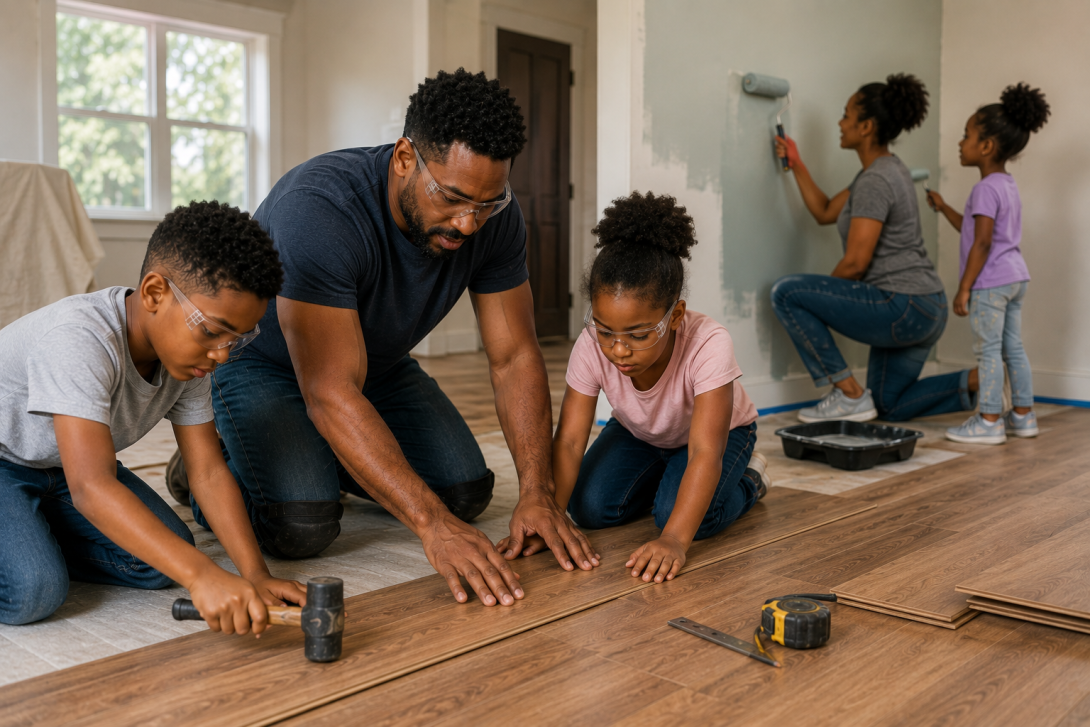
Whether it’s cooking dinner together, maintaining the house, serving in the community, helping a younger sibling in age-appropriate ways, helping an elderly family member, or tackling a difficult project together, children learn responsibility by sharing it.
The responsibility has to be real enough that their contribution matters. It can’t be busywork designed merely to keep them occupied.
Modern life makes it easy to separate children from the responsibilities that can help them become adults.
I understand the temptation.
Involving children often makes a task slower and messier. Sometimes it feels easier to carry the burden myself, hand them a distraction, and ask them to stay out of the way.
But efficiency may come at a cost.
When I always choose the fastest way to finish the work, I may also be removing the experiences that teach them how to contribute.
Somewhere along the way, protecting children can start to look like removing them from meaningful contribution altogether.
Standing on Your Own Doesn’t Mean Standing Alone
Teaching my children independence can’t only mean teaching them how to survive without me.
Together we are learning where to find and how to build communities. I want to teach them how to recognize the people they should build a life with.
What does a good friend look like? A trustworthy partner? A healthy community?
What kind of character should they look for in other people, and what kind should they develop in themselves?
Building a healthy community also helps compensate for my own limitations. I don’t have to be everything my children need, and they don’t have to learn the false lesson I learned too easily: that strength means handling everything yourself.
Part of resilience is knowing when someone respects you, when someone is taking more than they give, when you need to establish a boundary, when you need to ask for help, and when you need to offer it.
I don’t want my children growing up believing strength means not needing anyone. I want them to be able to stand on their own without believing they have to stand alone.
That requires more than life skills. It requires communication, community, and character.
Depending on good people is not the same thing as being incapable of taking care of yourself.
I’m still figuring out what all of this looks like in practice.
For now, I think about simple things: chores, errands and community service as opportunities to contribute in ways that actually matter.
But at what age do you begin sharing responsibility and to what degree? How much should a child carry? When do you step in, and when do you let them struggle? How do you give them support without removing every opportunity to discover what they can handle?
I don’t have all of those answers yet. But I know I don’t want to raise children whose greatest achievement is moving out.
I want to raise adults who know how to carry responsibility wherever they live.
If they choose to build a life somewhere else, I want them to leave feeling prepared. If they stay home for a season, I want them to stand beside me as another contributing adult, not simply another mouth to feed.
And wherever they go, I want them to know they don’t have to prove their strength by suffering alone.
I want them to have a real share of the work at home, but not responsibility for the stability of the family. I want them to contribute without having to compensate for the adults. I want to teach them independence without teaching them isolation.
I want my children to know a strength that doesn’t come from being forced to survive, but from knowing they matter, and their contribution matters.
That’s the kind of strength I want to pass down.